
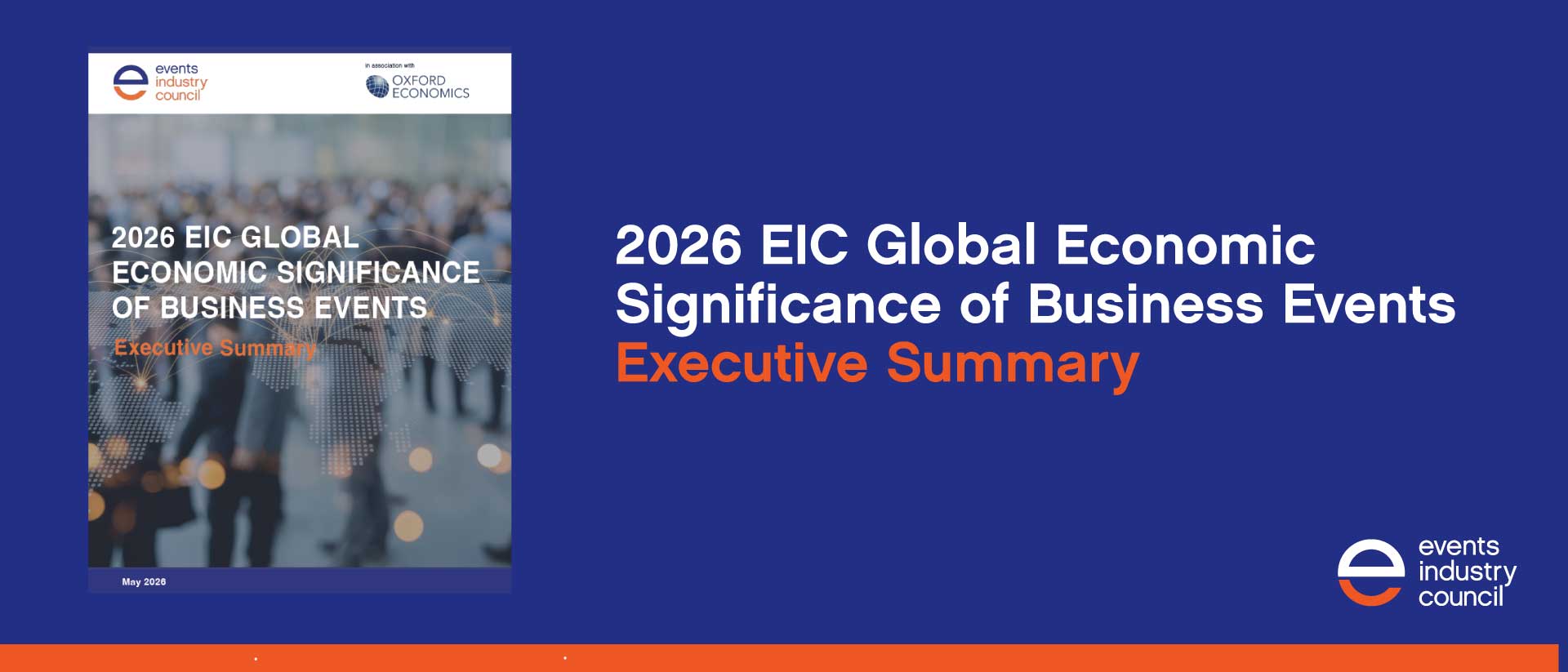
EIC and Oxford Economics study reveals business events as essential economic infrastructure
The Events Industry Council (EIC) has released the 2026 Global Economic Significance of Business Events Study Executive Summary, revealing the substantial economic contribution of the global Meetings, Incentives, Conferences and Exhibitions (MICE) industry.
Produced in partnership with Oxford Economics, the report provides one of the most comprehensive analyses of the business events sector, measuring its impact across more than 180 countries worldwide.
According to the study, business events in 2025 brought together approximately 1.65 billion participants globally and generated US$1.3 trillion in direct spending. The figures represent a 12.2% increase compared to 2019, underscoring the sector's strong post-pandemic recovery and continued expansion.
Beyond direct spending, the study found that the wider economic impact of business events is significantly larger when indirect and induced contributions are included.
The report estimates that in 2025 the sector supported US$3.1 trillion in total business sales, US$1.8 trillion in total Gross Domestic Product (GDP), and 24.2 million jobs worldwide.
The findings reinforce the role of business events as major economic drivers supporting tourism, hospitality, aviation, logistics, technology, professional services, and local supply chains.
Industry analysts note that conferences, exhibitions, trade fairs, and corporate meetings increasingly contribute to national economic development strategies, investment promotion, and international competitiveness.
Commenting on the findings, Amy Calvert described business events as "essential infrastructure" for a connected and resilient global economy.
She noted that the report provides credible and current data demonstrating the value created when people gather for conferences, exhibitions, and industry events.
According to Calvert, business events not only generate economic activity but also strengthen communities, accelerate knowledge exchange, foster innovation, and build the trust necessary for collaboration and decision-making across industries.
The study further highlights the importance of face-to-face engagement in advancing global progress, despite the growth of digital communication and virtual event platforms.
The findings arrive at a time when countries and cities worldwide are increasing investments in convention centres, exhibition infrastructure, tourism promotion, and aviation connectivity to attract a larger share of the growing global MICE market.
Experts increasingly view business events as strategic platforms for trade and investment attraction, knowledge transfer, innovation and research collaboration, policy dialogue, destination branding, and sector development.
The study also demonstrates how the industry contributes to long-term economic and social impact beyond tourism revenues alone.
As global competition for international meetings and exhibitions intensifies, the report is expected to strengthen advocacy efforts by industry stakeholders seeking greater recognition of business events as critical drivers of economic growth, innovation, and international cooperation.
Business events: Essential infrastructure for a connected global economy.
Strong post-pandemic recovery and continued expansion
"Business events are essential infrastructure for a connected and resilient global economy."
— Amy Calvert, Events Industry Council
Get MICE data and insights delivered to your inbox